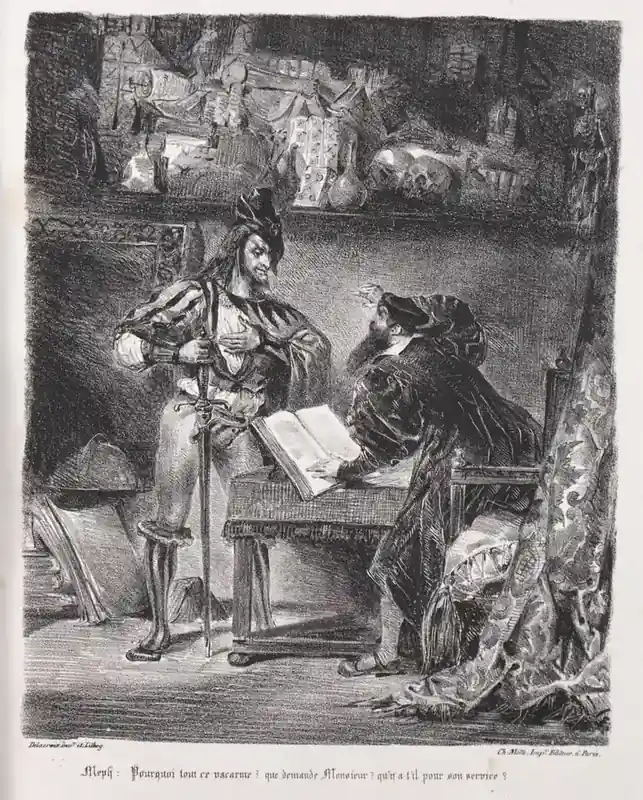
Jung wrote about Faust for fifty years. He read Mephistopheles as the shadow — the part of the personality the conscious ego cannot integrate but cannot live without — and he read the whole drama as a long argument that the shadow, when not denied, becomes the engine of the work the conscious mind could not do on its own. Mephistopheles is the figure who, in his own self-description, wills evil and works good. That formulation is not a paradox in Jung's reading. It is the operational definition of how the unconscious participates in conscious life when the person stops fighting it.
Helena, in Part II, is Jung's most direct reading of the anima — the inner feminine that, in the male psyche of Goethe's era, carries the affective and intuitive functions the ego has externalized. Jung's claim is not that Goethe was hallucinating an archetype; it is that the figure Goethe needed to write to complete the second half of his poem is the same figure that shows up in dreams and clinical material across cultures, because the structure of psyche that produces her is general. The Faust-Helena union dramatizes the coniunctio — the integration of contrasexual elements that Jung saw as the central work of the second half of life.
The closing Ewig-Weibliche — the eternal feminine that draws Faust upward — is the anima's teleological function. It is not a love object. It is the principle by which the personality is led past what reason alone can reach. Jung is careful here: he is not saying Goethe encountered a metaphysical truth. He is saying Goethe wrote the figure that the deep structure of psyche, working teleologically toward integration, produces in any person who lives long enough and pays attention.
What does contemporary depth psychology, with a century of clinical observation Jung did not have, see in Faust that he did not? Three things. First: the wager itself reads, in modern terms, as a defense against integration. Faust seeks novelty so the relational work of staying with anything cannot occur. Second: Gretchen is no longer simply the innocent destroyed by Faust's striving; she is the relational casualty that the work of striving consistently produces in lives organized around it. Third: the redemption at the end reads, to a clinician, less as a metaphysical gift than as the late-life recognition that the striving was always also a flight, and that something — Goethe's eternal feminine, a contemporary clinician's healthy attachment — was reaching back the entire time.
The shadow is not the amygdala. The anima is not the right hemisphere. The Ewig-Weibliche is not a default-mode trajectory. Each of those mappings is an attempt to collapse a phenomenological observation into a mechanism, and each loses the observation in the process. The brain regions discussed above and the psychic structures discussed here are different inquiries into the same person reading the same poem. Both are needed. Neither is sufficient.