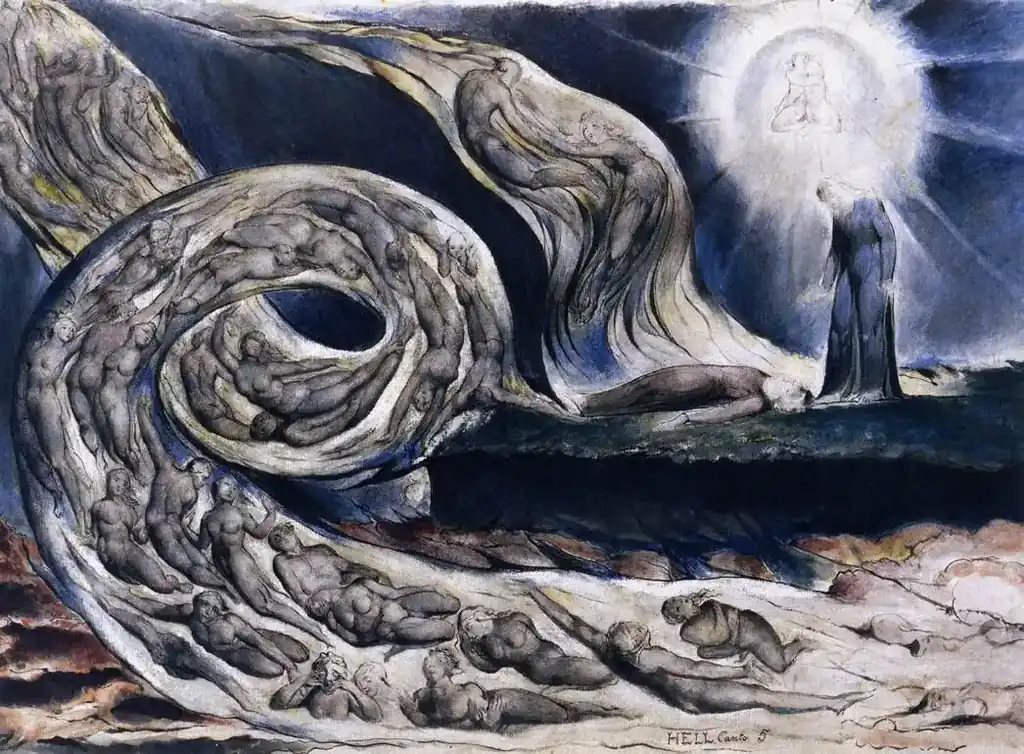
Three words do the structural work of the opening, and English cannot carry any of them cleanly. Nostra (our, not my) — Dante is not narrating his own midlife; he is positioning the reader inside a shared possessive that makes midlife a structural human event rather than an autobiographical one. Mi ritrovai is reflexive — I found myself — and the reflexive is doing work English cannot reproduce: the speaker is both the one who is lost and the one who finds himself lost. Diritta is polysemous — it means straight, right, and just, in one adjective, so the lost path is simultaneously geometrical, moral, and legal. English has to choose one or smuggle the others through context.
The whole tercet is in present-perfect — era smarrita, had been lost — locating the disorientation as a state that had already happened before the speaker noticed. This is the grammar of a default-mode network catching up to its own situation. The reader's brain processes the tercet by projecting forward into an autobiographical event (the midlife crisis is one of the most universally available self-reference frames) while parsing the polysemy of diritta, while holding the reflexive structure of ritrovarsi. Three operations at once. The English makes the reader do the same operations sequentially.
- PCC最强响应
- Precuneus中等响应
- dmPFC中等响应
- vmPFC中等响应
Literature-informed composite. Not a TRIBE measurement. Drawn from the neuroscience papers cited in the About page.
- IFG (L)中等响应
- Middle Temporal (L)中等响应
- PCC中等响应
- Precuneus微弱响应
Literature-informed composite. Not a TRIBE measurement. Drawn from the neuroscience papers cited in the About page.