本文へスキップ

このページはAIによって翻訳されており、ネイティブスピーカーによる校閲はまだ行われていません。英語版が正典です。

ダンテ

Dante, or: the architecture of moral attention.

Dante built the Commedia for the way a brain holds extended narrative across selfhood, embodiment, and felt rightness — seven centuries before any of those words existed.

Neurosynth メタアナリシス
Neurosynth meta-analysis · HCP-MMP-360 (Glasser 2016, doi:10.1038/nature18933) · CC0
Composition: autobiographical memory 40% · self referential 30% · navigation 30%Inferno I.1 � midlife frame, autobiographical self-locating.NiMARE MKDA-Chi2 meta-analysis on Neurosynth-v7 (>14,000 fMRI studies). Z-map projected to fsaverage5 via nilearn.surface.vol_to_surf, averaged within HCP-MMP-360 parcels, sigmoid-squashed (center=2.5, scale=1.2) into [0,1].Yarkoni et al., Nature Methods 2011, doi:10.1038/nmeth.1635Not a measurement of any individual brain. What you're seeing is the activation pattern published meta-analysis associates with the term composition above.
22 分で読了五楽章 · イタリア語 + 日本語
楽章 I3

枠組み。

The Commedia is not a religious poem with a moral allegory attached. It is a structure built around a single observation: moral life is felt before it is reasoned, the felt sense has its own architecture, and that architecture is rendered most accurately by a form that moves a body through it. Dante spent the last twenty years of his life writing a poem whose method is exactly this — to put the reader's own body through ascent, descent, recognition, and stillness, in a metric form (terza rima) whose rhyme scheme physically pulls the reader forward through the same architecture the narrator is moving through.

Dante had no access to fMRI, no theory of default-mode networks, no concept of embodied cognition. What he had was an extraordinary attention to the way moral experience actually feels, and a poetic form that he engineered to render that feeling as a structural property of reading rather than as a description in the third person.

The claim of this room: the Commedia is structured for the default-mode network and the embodied cognition of moral emotion in a way that contemporary cognitive neuroscience can now recognize but could not have predicted from theory alone.

楽章 II5

脳。

Raymond Mar's review of the neural bases of social cognition and story comprehension established that extended narrative engages the default-mode network — the same regions involved in self-referential thought, autobiographical memory, and the simulation of other minds. The default-mode network is what allows a reader to hold the entire trajectory of a long narrative in working consciousness while attending to the local sentence. The Commedia, at a hundred cantos and over fourteen thousand lines, is among the most demanding sustained narratives any reader will undertake, and its architecture is built precisely for what the default-mode network does best.

Speer, Reynolds, Swallow, and Zacks demonstrated that reading narrative about motor action activates the same neural representations as actually performing the action. When Dante describes the descent through the seven circles, the reader's motor-imagery regions activate. When the Purgatorio describes the climb up the mountain, those same regions activate again, in the opposite direction. The architectural orientation of the poem — down through Hell, up through Purgatory, outward through the spheres of Paradise — is being processed by a brain that, neuroscience now knows, treats described motion as embodied even when the body is not moving.

Wallentin and colleagues found that the amygdala and the autonomic nervous system respond to emotionally intense passages of fiction before the conscious reader registers what they are responding to. The body knows the Paolo and Francesca passage is going to hurt before the prefrontal cortex catches up. Dante engineered this. The terza rima carries the affective onset across line breaks faster than rational comprehension can keep up; by the time the reader has parsed the sentence, the body has already responded to it.

What would TRIBE v2 predict for the opening tercet of Inferno and the closing tercet of Paradiso? For the opening: default-mode core activation (the famous nel mezzo del cammin opens directly into autobiographical projection), strong dorsomedial prefrontal engagement (the shared nostra vita pulls the reader into mentalizing with the narrator), and reasonable activation across the language regions despite the model never having seen medieval Italian. For the closing: TRIBE goes thin. The model can locate l'amor che move il sole as a sentence about love and the sun and the stars, but the closing tercet is doing something the model has no parameters to represent — collapsing the entire prior architecture into a final embodied claim about the limits of vision and the priority of love.

The model is not the poem. The Commedia is doing work for a reader's brain that no measurement of that brain can fully describe. The neuroscience above is real and the predictions are honest, but the poem remains larger than any reading of it, including this one.

楽章 III5

プシュケー。

Jung wrote less directly on Dante than on Faust, but the structural reading is straightforward: the descent into Inferno is the canonical nekyia — the journey into the underworld that, since the Odyssey, has been Western literature's most stable symbol for the encounter with the unconscious. Virgil is the wise old man who can accompany the conscious ego through the lower regions but cannot, by his nature as a pre-Christian rationalist, escort it past the boundary of reason. Beatrice is the anima made explicitly theological — the inner feminine elevated to the function of guide into what reason alone cannot reach.

The contrapasso — the principle that each circle's punishment is structurally identical to the sin that produced it — is, in psychological terms, a phenomenology of schema-driven repetition seven centuries before schema theory existed. The lustful are blown by the winds they could not resist in life. The flatterers wallow in the filth their words spread. The traitors are encased in the ice their hearts had already become. Dante is not punishing his characters; he is rendering the structure by which inner states produce their own continuation. The sin is the punishment. Modern clinicians recognize this as the operational definition of a personality structure.

The Purgatorio is, in this reading, a sustained meditation on what depth psychology calls the integration of the shadow — the work of recognizing the parts of the self that have been disowned and bringing them, gradually and with care, back under the orbit of the central personality. Dante climbs the mountain by repeatedly facing what was rejected. Each terrace is a confrontation with a specific disowned content. The Purgatorio's prosody — terza rima continuing through the climb — carries the felt experience of integration as forward motion against gravity.

The Paradiso is the most difficult of the three for psychology to read because it stages a structure that depth psychology can only describe by analogy: the integration of the contrasexual function (Beatrice) into the central personality, the dissolution of the boundary between self and the larger Self, and finally the vision in which the personal will is aligned with the moving principle of the universe. Jung would call this the late stage of individuation. Dante calls it Paradise. The two languages are pointing at structurally similar territory; they are not synonyms.

The contrapasso is not the basal ganglia. Beatrice is not the right hemisphere. The unmoved mover at the end of Paradiso is not a default-mode trajectory. The temptation to translate Dante's symbolic structures into the brain regions discussed in Movement II is exactly the collapse the site refuses elsewhere. The poem is doing something at the level of meaning and felt experience that the level of mechanism can describe in part and not in whole. Hold both.

楽章 IV7

言語。

Three passages. For each, the Italian first, an English translation alongside, and a note on what the original is doing that the translation cannot carry. Dante's medieval Italian is even further outside any brain-encoding model's training distribution than modern Thai is; the divergence between original and translation here is sharper than in any other room on this site.

一節 IInferno, Canto I, lines 1–3
イタリア語 (原文)
Nel mezzo del cammin di nostra vita mi ritrovai per una selva oscura, ché la diritta via era smarrita.
日本語
Midway upon the journey of our life I found myself within a forest dark, For the straightforward pathway had been lost.
trans. Henry Wadsworth Longfellow (1867). Public domain.

Three words do the structural work of the opening, and English cannot carry any of them cleanly. Nostra (our, not my) — Dante is not narrating his own midlife; he is positioning the reader inside a shared possessive that makes midlife a structural human event rather than an autobiographical one. Mi ritrovai is reflexive — I found myself — and the reflexive is doing work English cannot reproduce: the speaker is both the one who is lost and the one who finds himself lost. Diritta is polysemous — it means straight, right, and just, in one adjective, so the lost path is simultaneously geometrical, moral, and legal. English has to choose one or smuggle the others through context.

The whole tercet is in present-perfect — era smarrita, had been lost — locating the disorientation as a state that had already happened before the speaker noticed. This is the grammar of a default-mode network catching up to its own situation. The reader's brain processes the tercet by projecting forward into an autobiographical event (the midlife crisis is one of the most universally available self-reference frames) while parsing the polysemy of diritta, while holding the reflexive structure of ritrovarsi. Three operations at once. The English makes the reader do the same operations sequentially.

イタリア語を読む
  • PCC最も強い反応
  • Precuneus中程度の反応
  • dmPFC中程度の反応
  • vmPFC中程度の反応

Literature-informed composite. Not a TRIBE measurement. Drawn from the neuroscience papers cited in the About page.
翻訳を読む
  • Broca's region (L)中程度の反応
  • Middle Temporal (L)中程度の反応
  • PCC中程度の反応
  • Precuneusわずかな反応

Literature-informed composite. Not a TRIBE measurement. Drawn from the neuroscience papers cited in the About page.

一節 IIInferno, Canto V, lines 121–138 (Paolo e Francesca)
イタリア語 (原文)
Nessun maggior dolore che ricordarsi del tempo felice nella miseria; e ciò sa 'l tuo dottore. Ma s'a conoscer la prima radice del nostro amor tu hai cotanto affetto, dirò come colui che piange e dice. Noi leggiavamo un giorno per diletto di Lancialotto come amor lo strinse; soli eravamo e sanza alcun sospetto.
日本語
There is no greater sorrow Than to be mindful of the happy time In misery, and that thy Teacher knows. But, if to recognise the earliest root Of love in us thou hast so great desire, I will do even as he who weeps and speaks. One day we reading were for our delight Of Launcelot, how Love did him enthral. Alone we were and without any fear.
trans. Henry Wadsworth Longfellow (1867). Public domain.

Ricordarsi is the load-bearing verb and English has no clean equivalent. The Italian holds the etymological structure of ri-cor-dare — to put back into the heart. Memory in this passage is not a cognitive operation; it is a physical relocation of an event into the body's seat of feeling. Francesca is not remembering the happy time; she is putting it back into her heart. The pain she names is not the cognitive recognition of past happiness in present misery; it is the somatic experience of the happy time as a foreign body that her heart cannot reject and cannot incorporate.

The terza rima is doing affective work English translations cannot reproduce. Each tercet's rhyme reaches forward into the next tercet's first line and back into the previous tercet's last line, so the reader's brain is held in three temporal registers simultaneously. By the time conscious comprehension parses what Francesca has said, the body has already absorbed the felt force of saying it. Wallentin's amygdala research is being demonstrated in the prosody itself: the affective onset precedes the cognitive integration. Dante engineered the schedule.

イタリア語を読む
  • Amygdala (L)最も強い反応
  • Amygdala (R)最も強い反応
  • Hippocampus (L)中程度の反応
  • Hippocampus (R)中程度の反応

Literature-informed composite. Not a TRIBE measurement. Drawn from the neuroscience papers cited in the About page.

翻訳を読む
  • Amygdala (L)中程度の反応
  • Hippocampus (L)中程度の反応
  • vmPFC中程度の反応
  • Middle Temporal (L)わずかな反応

Literature-informed composite. Not a TRIBE measurement. Drawn from the neuroscience papers cited in the About page.

一節 IIIParadiso, Canto XXXIII, lines 142–145
イタリア語 (原文)
A l'alta fantasia qui mancò possa; ma già volgeva il mio disio e 'l velle, sì come rota ch'igualmente è mossa, l'amor che move il sole e l'altre stelle.
日本語
Here vigour failed the lofty fantasy: But now was turning my desire and will, Even as a wheel that equally is moved, The Love which moves the sun and the other stars.
trans. Henry Wadsworth Longfellow (1867). Public domain.

The whole Commedia ends on l'amor che move il sole e l'altre stelle, and there is, in European poetry, no denser semantic load placed on a single closing line. L'amor — not romantic love, not affection, but the metaphysical principle of motion that medieval theology saw as the prime mover. Move is the verb at the structural center: love is what moves, in the sense of physical motion, the sun and the other stars. The pronoun e l'altre stelle includes the sun in the category of stars and reminds the reader, in passing, that the cosmology has just been revised from earth-centered to something else.

What the brain-encoding model has no parameters to represent: the tercet's claim that vision failed (qui mancò possa) and love completed what vision began. The Paradiso is structured around the limits of seeing — Dante's vision burns out repeatedly across the final cantos — and the closing tercet stages the moment when the conscious cognitive apparatus simply cannot continue, and something else takes over and finishes the journey. The model can locate the words; it cannot represent the structural event of the words being the last words. The silence after them is part of the finding. So is the silence inside any brain-encoding model when asked what to do with this passage.

イタリア語を読む
  • vmPFC中程度の反応
  • PCC中程度の反応
  • Precuneus中程度の反応
  • Anterior Temporal (R)中程度の反応

Literature-informed composite. Not a TRIBE measurement. Drawn from the neuroscience papers cited in the About page.

翻訳を読む
  • Broca's region (L)中程度の反応
  • Middle Temporal (L)わずかな反応
  • vmPFCわずかな反応

Literature-informed composite. Not a TRIBE measurement. Drawn from the neuroscience papers cited in the About page.

三角測量

Three movements, three angles. Movement II showed how a brain-encoding model would receive the Commedia — the default-mode signature of extended narrative, the motor-imagery of described descent and ascent, the autonomic response to the emotionally heavy passages. Movement III named the psychic structures — nekyia, wise old man, anima as theological guide, contrapasso as the phenomenology of schema-driven repetition, the final integration that depth psychology can only describe by analogy. Movement IV worked the Italian — the shared possessive of nostra vita, the somatic etymology of ri-cor-dare, the closing line where the model goes thin and the poem completes.

These three are not three views of the same fact. They are three different inquiries into the same person reading the same poem. The brain regions of Movement II are not the psychic structures of Movement III, and neither is the terza rima itself. The temptation to map nekyia onto a default-mode trajectory, or contrapasso onto basal-ganglia repetition, or the closing love onto a ventromedial valuation signal — each of those collapses costs the observation. Hold all three. Refuse the collapse.

The Commedia does something none of the three registers can fully describe. It stages a soul learning, in time, what attention is for. The brain encoding model can tell us about reception. The depth-psychological reading can tell us about meaning. The language work can tell us about prosody. The poem is doing what is left.

楽章 V2

像。

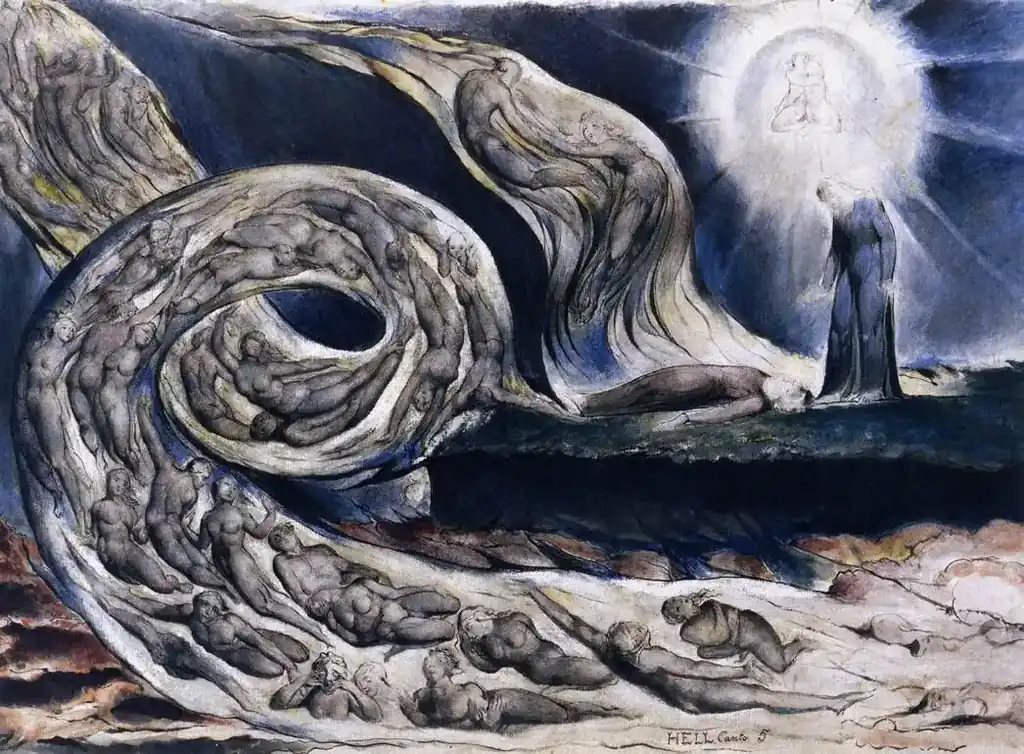
William Blake, The Whirlwind of Lovers (Francesca da Rimini and Paolo Malatesta), 1824–1827
William Blake · The Lovers' Whirlwind (Paolo and Francesca) · 1824–1827 · Birmingham Museums Trust · Public domain

William Blake spent the last three years of his life on a set of one hundred and two illustrations for the Commedia. He was sixty-seven when he began, dying of an unidentified wasting illness, with no patron and no clear plan for the works' publication. He completed seven of the watercolours fully; the rest are at various stages of underdrawing. The unfinishedness is not an accident of his death — it is, in retrospect, the right state for the project. Blake was reading Dante as someone reading their own forthcoming death, and the illustrations have the quality of having been made on a deadline that nobody set explicitly.

What Blake saw and chose to render was the prosody. The Whirlwind of Lovers does not show Paolo and Francesca as figures; it shows the wind that carries them, in a single sweeping line that doubles back on itself with the same forward-and-back motion the terza rima has on the page. What Blake chose to leave unrenderable is the conversation. Francesca's speech in Canto V is the most famous monologue in the Inferno, and Blake gives her no mouth. The image is what happens after the words have been said and the wind has them again.

The image, in this room's argument, is the fourth register. The brain encoding model receives the words. The depth-psychological reading interprets the figures. The language work hears the terza rima. Blake's watercolour offers the wind as something a body has actually felt. Four registers, one poem, more remaining.

対の部屋